nettobegroup
Business Data Analytics – How to make informed decisions based on Data
As business leaders and decision-makers, we must make informed decisions that will shape the company’s future. Sometimes, we need to make immediate decisions because the trend or economic environment is changing, and we must respond quickly to these changes.
Decades ago, business decisions were taken chiefly from “experience”, intuitions or even gut feelings. Many decisions were more about risk-taking rather than completely calculated moves. Many times, those efforts were successful, but there have also been numerous failures.
The economic landscape changes so rapidly today that decisions must often be taken quickly, but what decisions should we take? How do we still make these decisions while limiting the failure rate and ensuring we are making choices based on real facts and information rather than hearsay, trends or word of mouth?
This is where Business Data Analytics plays a crucial role. As the name suggests, it is data that allows us to analyse how our business is doing, giving us realistic, factual information. However, this can only be possible if we have in place solutions and business applications that allow us to correctly collect data related to all our business operations.
Business Data Analytics is the process of collecting data across all possible applications and platforms, allowing us to analyse the data and understand how the company is performing. When properly deployed, Business Data Analytics significantly reduces uninformed decision-making. Moreover, it allows us to foresee positive or negative trends, enabling us to take decisions proactively rather than reactively.
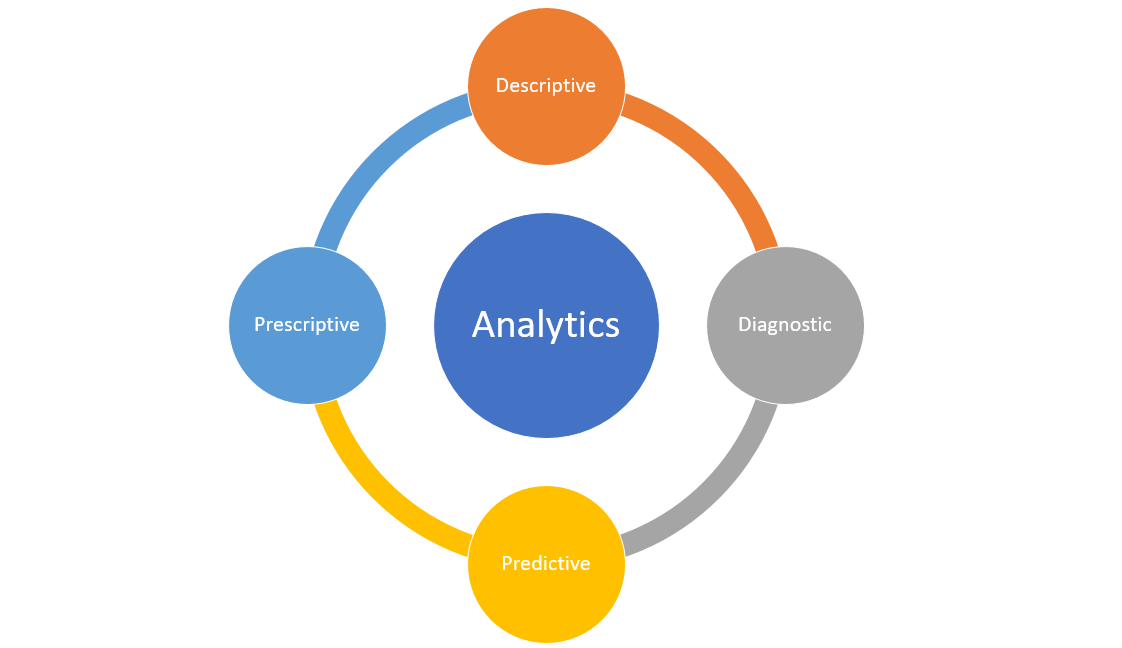
Four main types of Business Analytics can be done. I would like to provide a brief description of them, explain their importance, and outline how they can benefit a business.
The Four Types of Business Analytics:
A Fashion & Jewellery Company Case Study
Imagine a company that sells both fashion apparel and jewellery. Like many businesses, it wants to understand customer behaviour, manage stock efficiently, and grow profits while reducing risks. Let’s see how the four types of Business Analytics work in this context:
Descriptive Analytics – What happened?
The company begins by examining its past sales data. Reports show that during December, jewellery sales increased by 40% compared to other months, while clothing sales remained stable. It also notices that online sales are growing faster than in-store purchases.
→ Descriptive Analytics tells the company what has already happened—a sales spike in jewellery during the festive season and a shift towards online shopping.
Diagnostic Analytics – Why did it happen?
Next, the company investigates the reasons behind these results. It discovers that the jewellery spike was mainly due to Christmas promotions and gift purchases. Customer feedback shows that jewellery ads on social media had a substantial impact, while clothing ads were less engaging.
→ Diagnostic Analytics helps the business see why the results occurred: seasonal buying patterns, targeted promotions, and stronger marketing performance for jewellery.
Predictive Analytics – What is likely to happen?
Using past data, the company applies Predictive Analytics to forecast future behaviour. It finds that jewellery sales are likely to rise again around Valentine’s Day and Mother’s Day, while fashion sales are expected to grow during the summer due to tourism.
→ Predictive Analytics gives foresight, helping the company anticipate demand and prepare stock, marketing, and staffing ahead of time.
Prescriptive Analytics – What should we do?
Finally, Prescriptive Analytics takes it one step further. It suggests specific actions:
- Increase jewellery stock before Valentine’s Day and run gift-oriented campaigns.
- Introduce bundle offers that combine fashion and jewellery for cross-selling.
- Shift part of the marketing budget towards online platforms, where engagement has proven stronger.
- → Prescriptive Analytics not only predicts outcomes but guides decisions, allowing leaders to act proactively and strategically.
Why This Matters
By applying these four levels of analytics, the fashion and jewellery company moves from simply reporting results to understanding causes, forecasting the future, and deciding the best course of action. Instead of relying on gut instinct or guesswork, the business uses data to:
- Prepare for seasonal demand.
- Allocate marketing spend effectively.
- Reduce the risk of overstocking or understocking.
- Boost sales through more innovative promotions.
This step-by-step approach demonstrates how Business Data Analytics transforms raw information into actionable strategies, providing leaders with both speed and confidence in their decision-making.